In this article
A custom Shopify theme pays off when your store has traffic but orders do not match it, and an off-the-shelf template makes you look like every other shop. A new theme does not fix anything on its own, though. First you need to know where exactly customers leave, and only then build.
That is how we worked with Gene Streetwear, a streetwear brand from New York. Below we describe what they came to us with, how we looked for the drop-off points and why we built our own theme instead of tweaking a template.
The starting point: traffic without orders
People know Gene Streetwear and the store gets decent traffic. The conversion rate did not match it at all. Visitors browsed the collection and left, and the brand did not know at which stage of the purchase it was losing them.
The second problem was the look. The store ran on an off-the-shelf Shopify template and it showed: it looked like hundreds of other stores and did not carry the brand's mood. In streetwear, where identity is what sells, that is a serious weakness.
- The traffic is there, the conversion rate is not.
- Nobody knows at which stage people leave.
- A template that looks like everyone else's.
Why not start with a redesign
The usual response to weak sales is „let's do a new design“. But a redesign without numbers is guesswork. You can end up with a prettier store that sells just as badly, because the problem was somewhere else entirely, in size selection or in the length of the checkout.
So with Gene we started by measuring. We worked from the store's data and walked the whole customer journey as an ordinary visitor, from the homepage through picking a size to payment. We cared about one thing: where people disappear.
Once you know at which stage the customer leaves, the design knows what to fix.
How we find where customers drop off
A conversion audit does not have to be complicated. It means walking through the purchase step by step and asking at each step what could stop the customer. We then rank the drop-off points by impact, not by what we personally dislike.
- 1Go through the store's data and see how many people reach each step of the purchase.
- 2Walk through the store as a customer, on mobile and desktop.
- 3At each step, mark what slows down or confuses: missing information, an unnecessary click, slow loading.
- 4Rank the problems by their impact on orders.
- 5Turn the most important ones into the brief for the new theme.
For Gene this produced a list of what the new store had to solve. Only with that in hand did we start designing. The upside is that every design decision then has a reason behind it and can be defended, rather than just „we like it more“.
A custom Shopify theme, not a tweaked template
There is a big difference between adjusting a template and building your own theme. A template has a fixed structure the brand has to fit into. A custom theme is built around the brand and around how its customers shop.
Templates also tend to be generic. They carry lots of sections and settings for every kind of store, and whatever you do not use often just adds code and slows the page down. A custom theme contains only what the store actually needs, and we design every part with mobile in mind, where most people shop.
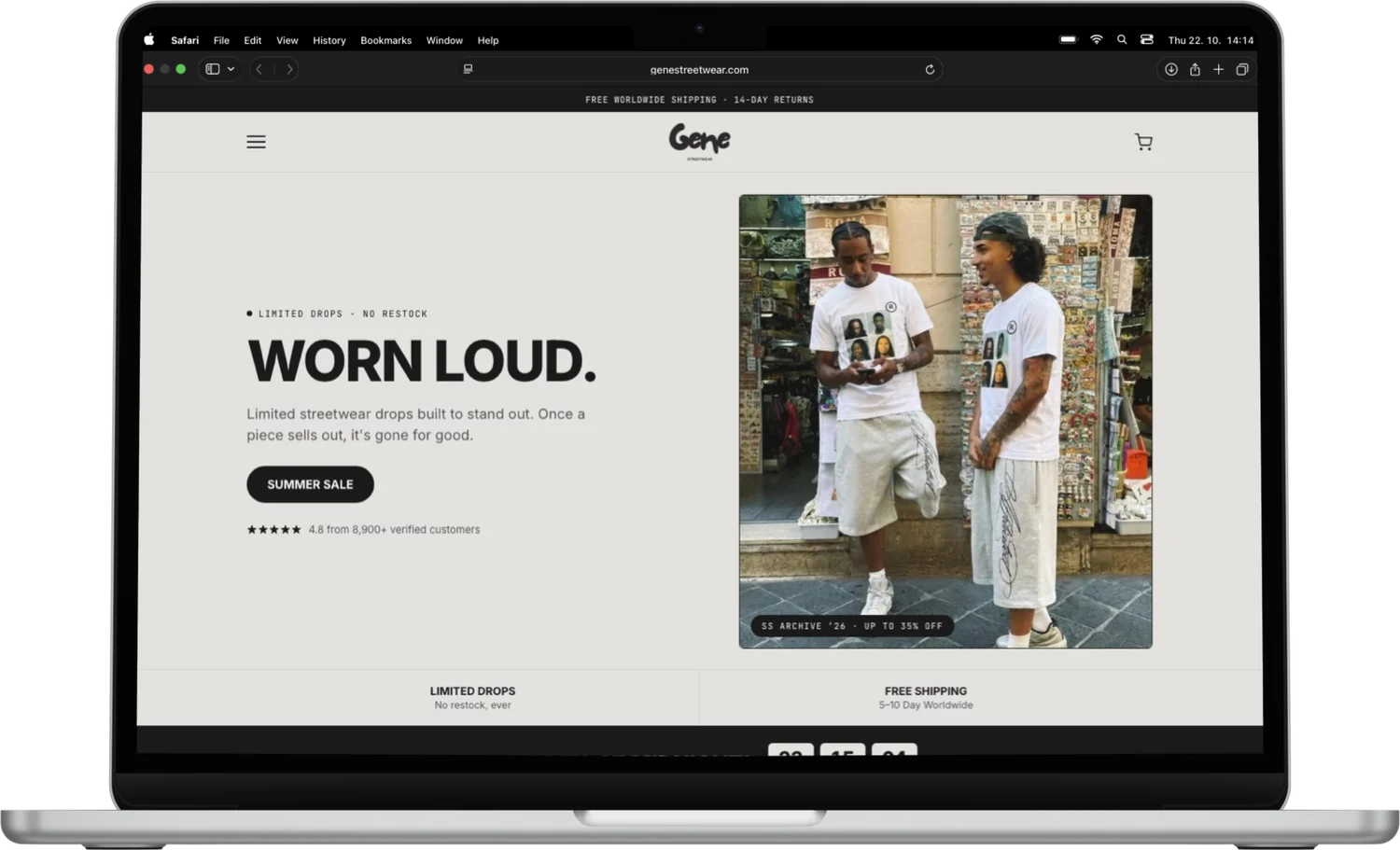
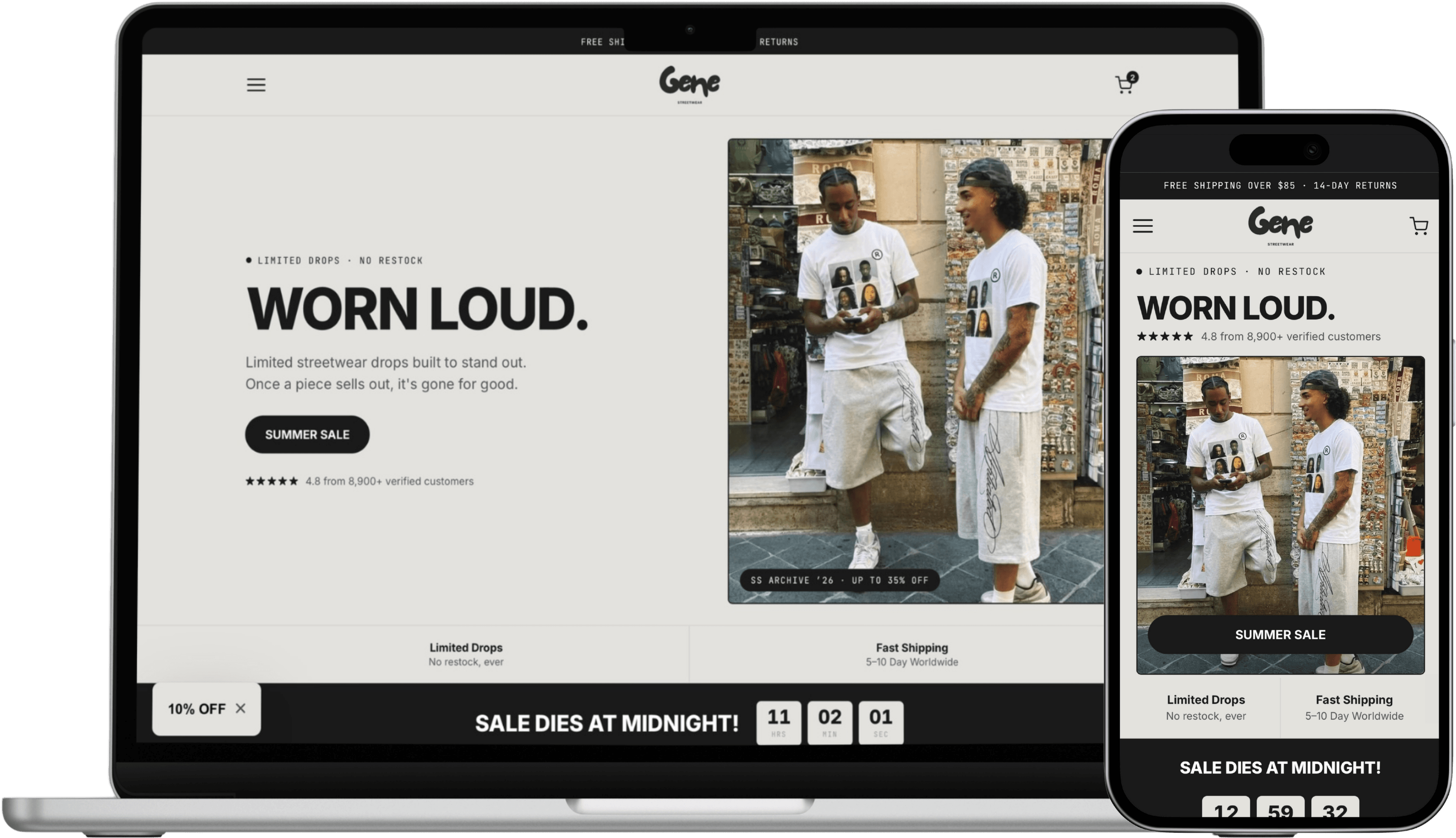
For Gene we coded a custom Shopify theme. Typography, grid and product page come from the brand, not from a template: a light surface and bold type. The lead role went to the limited drop and its countdown, which sit on the homepage together with availability.
- Design in the brand's language, so nobody mistakes you for another store.
- Limited drop logic: countdown and availability in plain sight.
- One clear path to the cart instead of many detours.
- Sizes and availability up front on the product page.
- Speed and thumb-friendly controls on mobile.
How we handle it
We let Shopify do what it is good at: payments, stock, orders and product management. We only build custom what the customer sees. The brand keeps working in the admin it knows and nothing breaks.
A shorter path to checkout
The last part of the work was the purchase itself. We shortened the path to the cart and to payment and refined size selection and availability. The aim was that nothing unnecessary stands between wanting something and ordering it.
With clothing, size selection is a critical point. The customer needs to know what is in stock and how it fits, without searching. Every extra step, pop-up or unclear error message is a reason to put the purchase off, and a postponed purchase is often never finished.
The same goes for speed. Clothing stores have many large product photos, so how they load matters. Google also measures page speed and stability through Core Web Vitals, so a slow store loses customers in search as well.
When a custom Shopify theme pays off
A custom theme is not for every store. If you are just starting out and have no traffic yet, a template will serve you for a long time and the money makes more sense in marketing. A custom theme makes sense in these situations:
- The store has traffic, but orders lag behind.
- The brand is built on identity and the template dilutes it.
- You sell differently from a regular shop, for example in limited drops.
- You have adjusted the template so many times that every change breaks something.
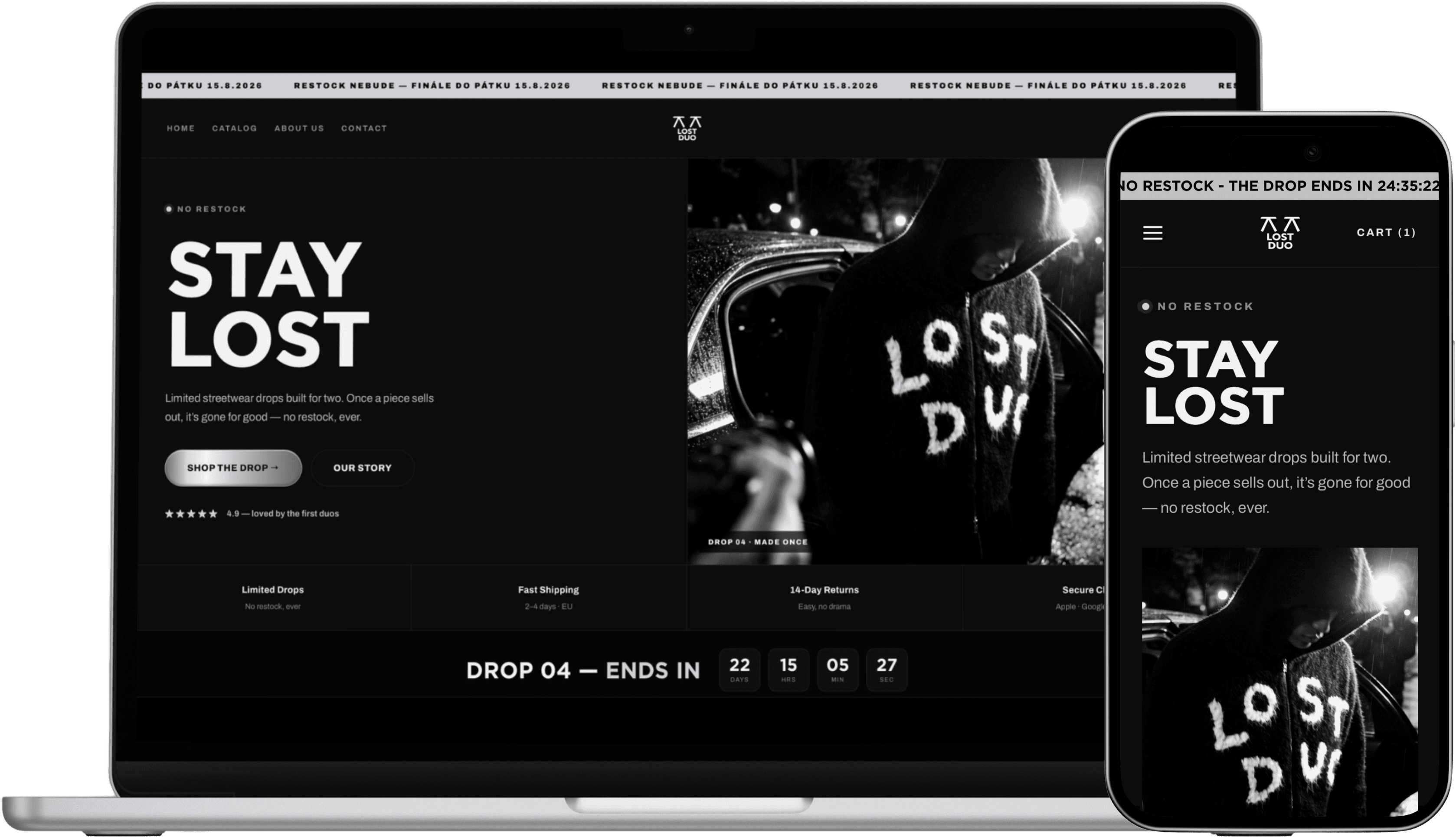
We have built Shopify themes for other brands too, such as LOST DUO and Mind of Life.
What a custom Shopify theme costs
A custom online store falls under our Premium website from CZK 39,900. The final price depends on the number of page types, whether a conversion audit is part of the job, and special logic such as drops or countdowns. The Shopify monthly fee is paid separately, directly to Shopify.
We always agree a fixed price up front and start with a free demo. We explain how a website price adds up in How much a business website costs, and indicative prices are in our pricing.
The full Gene Streetwear story is in the case study. If your store gets visitors who do not buy, get in touch. We will go through it with you and show you where customers leave.
FAQ
- 1
What is a custom Shopify theme?
It is the look and structure of a Shopify store designed and coded for your brand, not an adjusted off-the-shelf template. Payments, stock and the admin stay in Shopify.
- 2
How much does a custom Shopify theme cost?
With us a custom store starts at CZK 39,900 as part of the Premium website. Scope, a conversion audit and special features affect the price, and the Shopify fee is paid separately.
- 3
Why does my store have traffic but few orders?
There are usually several causes: unclear availability, awkward size selection, a long checkout or a slow mobile site. That is why we recommend walking the customer journey first to find where people leave.
- 4
Do I lose the Shopify admin with a custom theme?
No. You keep managing products, orders and stock in the regular Shopify admin, the theme only changes what the customer sees.
Related project
Gene Streetwear
Streetwear e-shop · Shopify
Full case study ›
Want this on your website?
We build you a free demo. You only pay if you like it.