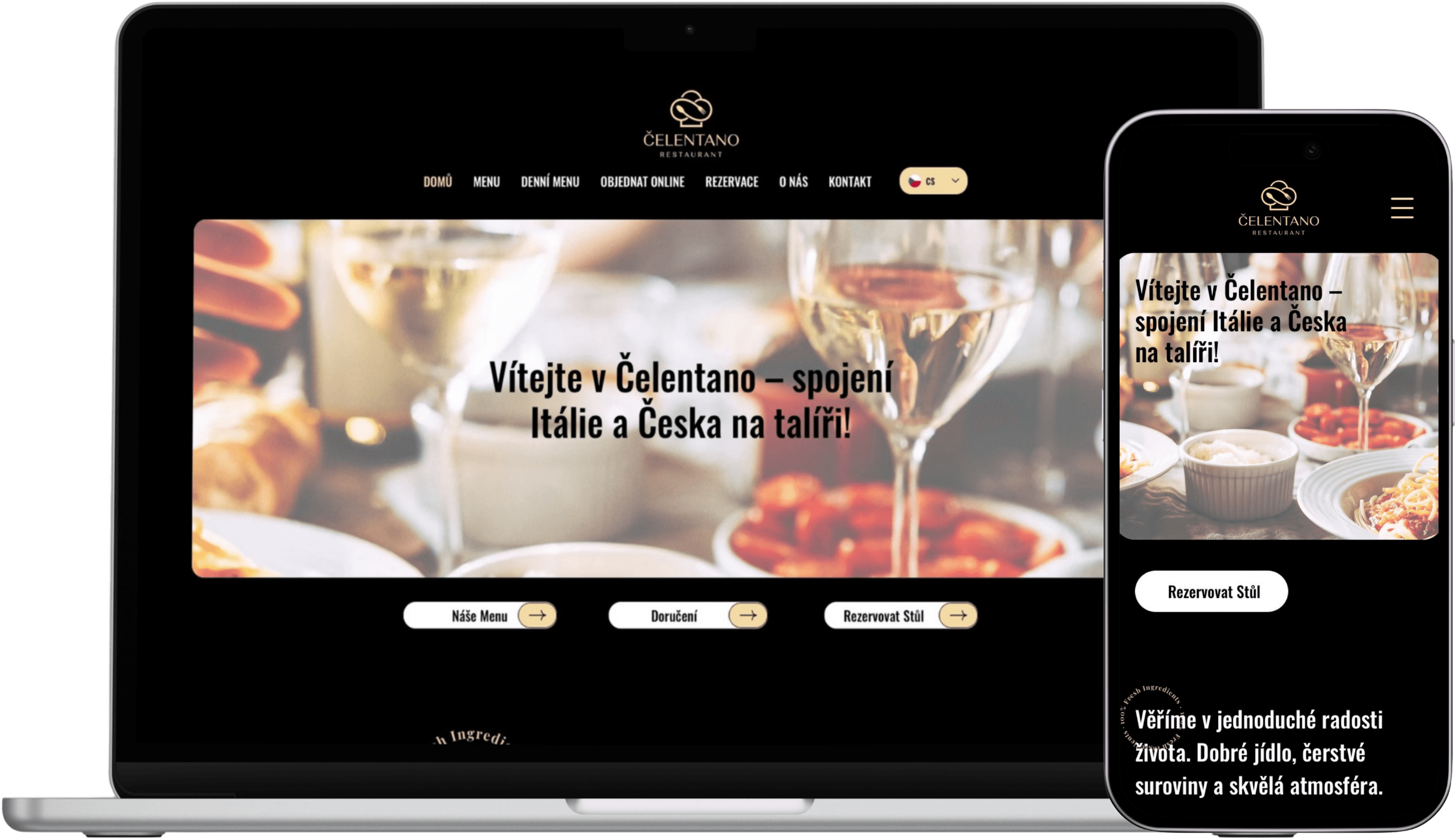
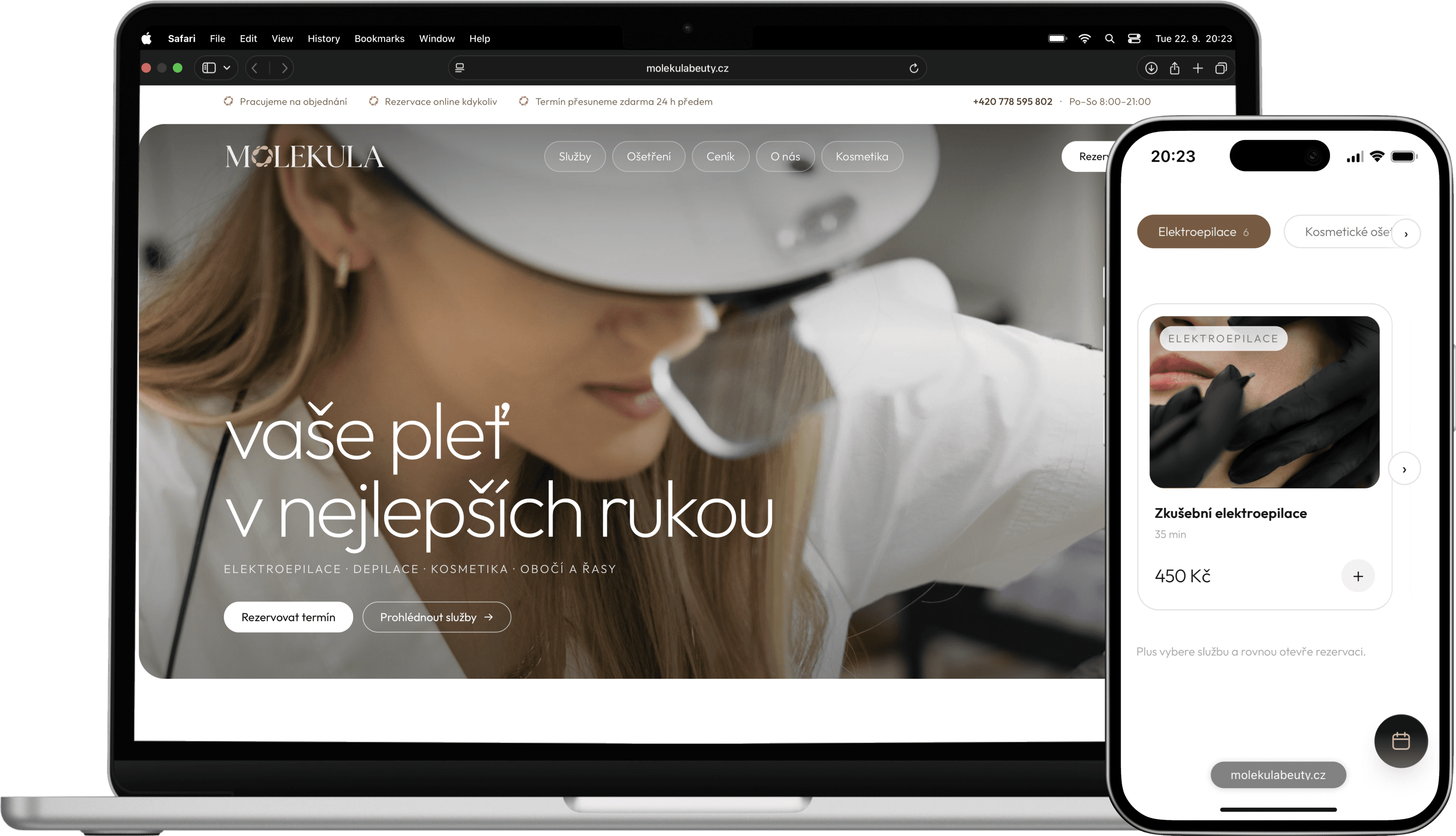
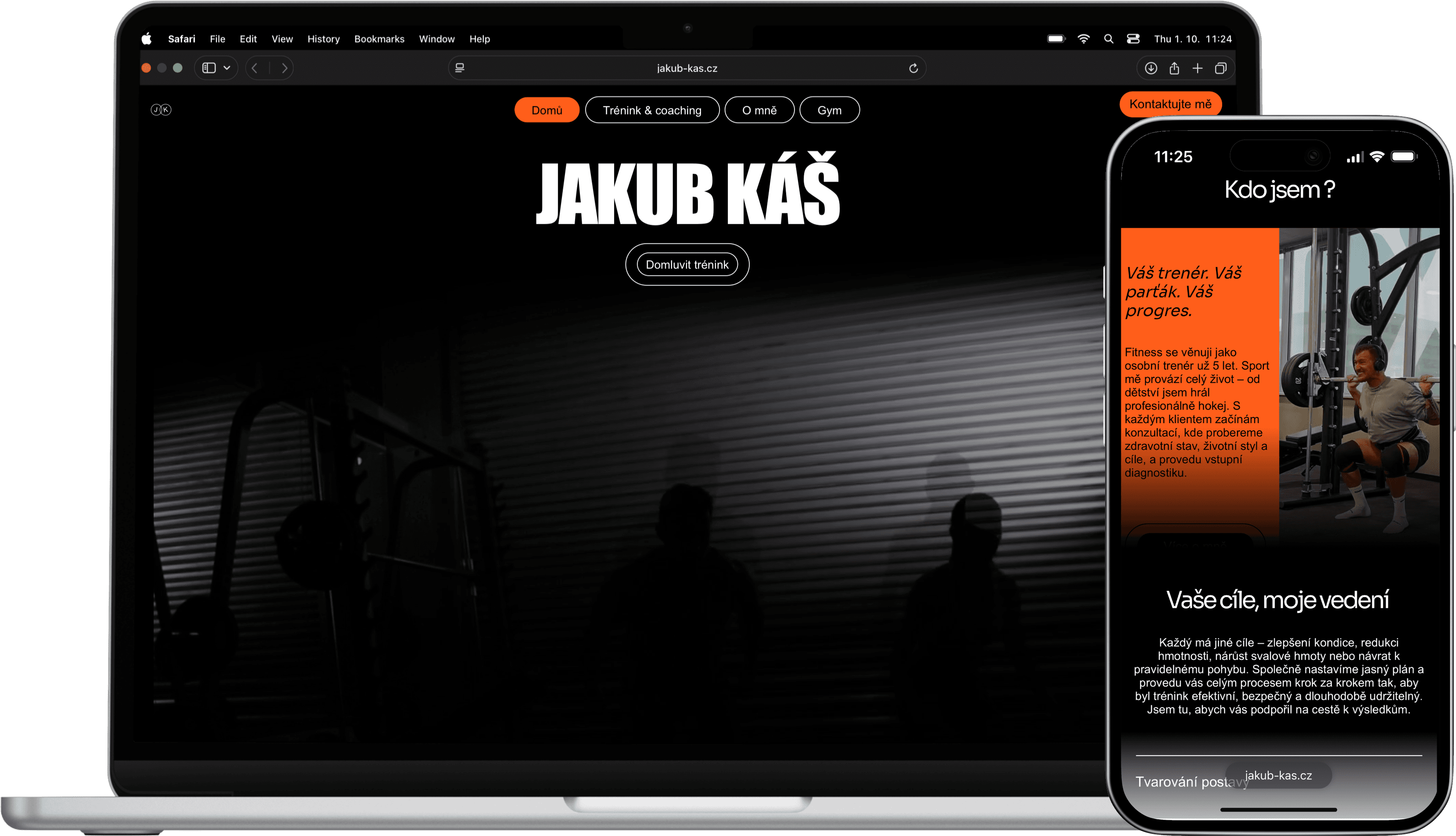
In this article
The website or web application question has a simple answer: a website is for people outside, a system is for people inside. The website shows what you do and brings in enquiries. A web application (a custom system) handles what happens next with that enquiry, job or booking. Plenty of businesses mainly need the first, some are already running into the second.
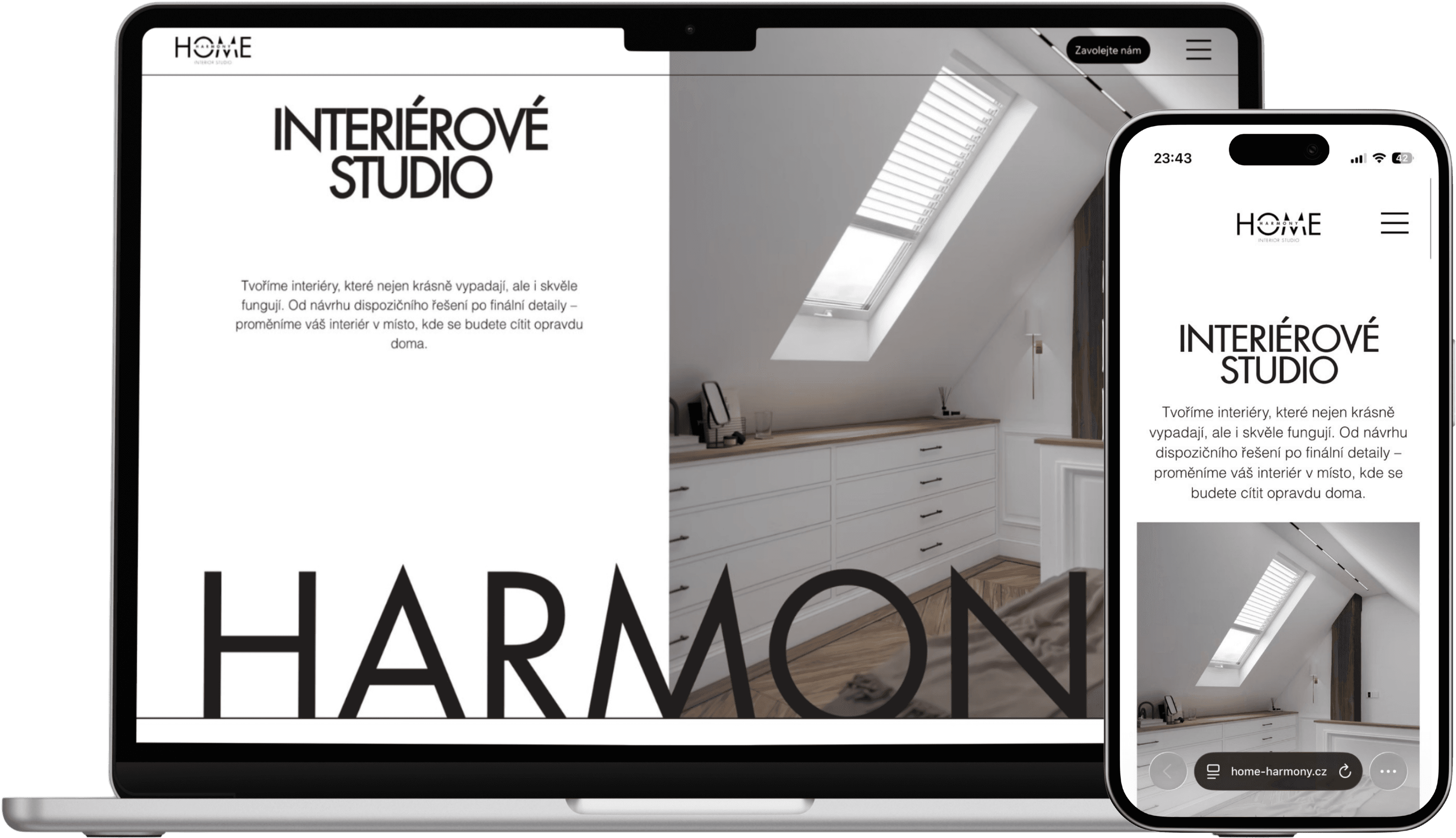
We will show it on the interior studio Home Harmony, where we built both: a website for clients, the Můj den app for the team and a graphics generator for Instagram.
A website shows and sells, a system works
A website is the shop window. It should be fast, clear on a phone, findable on Google and lead visitors to get in touch. You judge it by how many people reach out.
A system is the workshop. It works with data that changes every day: bookings, jobs, clients, invoices, tasks. You judge it by how much time and how many mistakes it saves. So when choosing between a website and a web application, first ask where it hurts more today.
A website fixes how customers see you. A system fixes how work gets done.
When a website is enough
A website is enough when your main problem is that people cannot find you or do not understand what you offer. Typically a business with no site, an outdated one or one that breaks on a phone. Customers have to find you first, only then does it make sense to tune what happens inside.
- Customers get in touch by phone or e-mail and you handle it without chaos.
- Your offer does not change daily, a few edits a month are enough.
- Bookings run through a proven tool that can be connected to the site.
- Internal admin is handled by one person or a simple spreadsheet.
In that case building an app is a waste. A good custom website starts at CZK 24,900 with us, a one-page site at CZK 14,900. See pricing for the overview and Web design Prague for what a good site involves.
When you need a custom system
A system starts to make sense when the business keeps doing the same work by hand, information gets lost in e-mails and nobody is sure what is done. In other words, when you have outgrown Excel. We go deeper in When a business outgrows Excel.
- Jobs in stages: you need to see where each job is and who is on it.
- Repeated paperwork: you retype contracts, quotes or invoices by hand.
- Several people, one set of data: the team needs a shared calendar, tasks and notes.
- Content that changes daily: menus, apartment status or slots you do not want to send to a developer.
A system does not mean huge software. Often it is a few screens built exactly for how you run: bookings and slots, CRM and jobs, a contract generator, automated e-mails, reports and exports for your accountant, or access and roles for the team.
How a website and a system work together: Home Harmony
Home Harmony is an interior studio from Prague. The site started in Wix Studio and now runs on our own code with the same black and white look. It gained a price calculator, a style quiz, a three-step enquiry and an English version. That is still a website: it shows projects and leads to an enquiry.
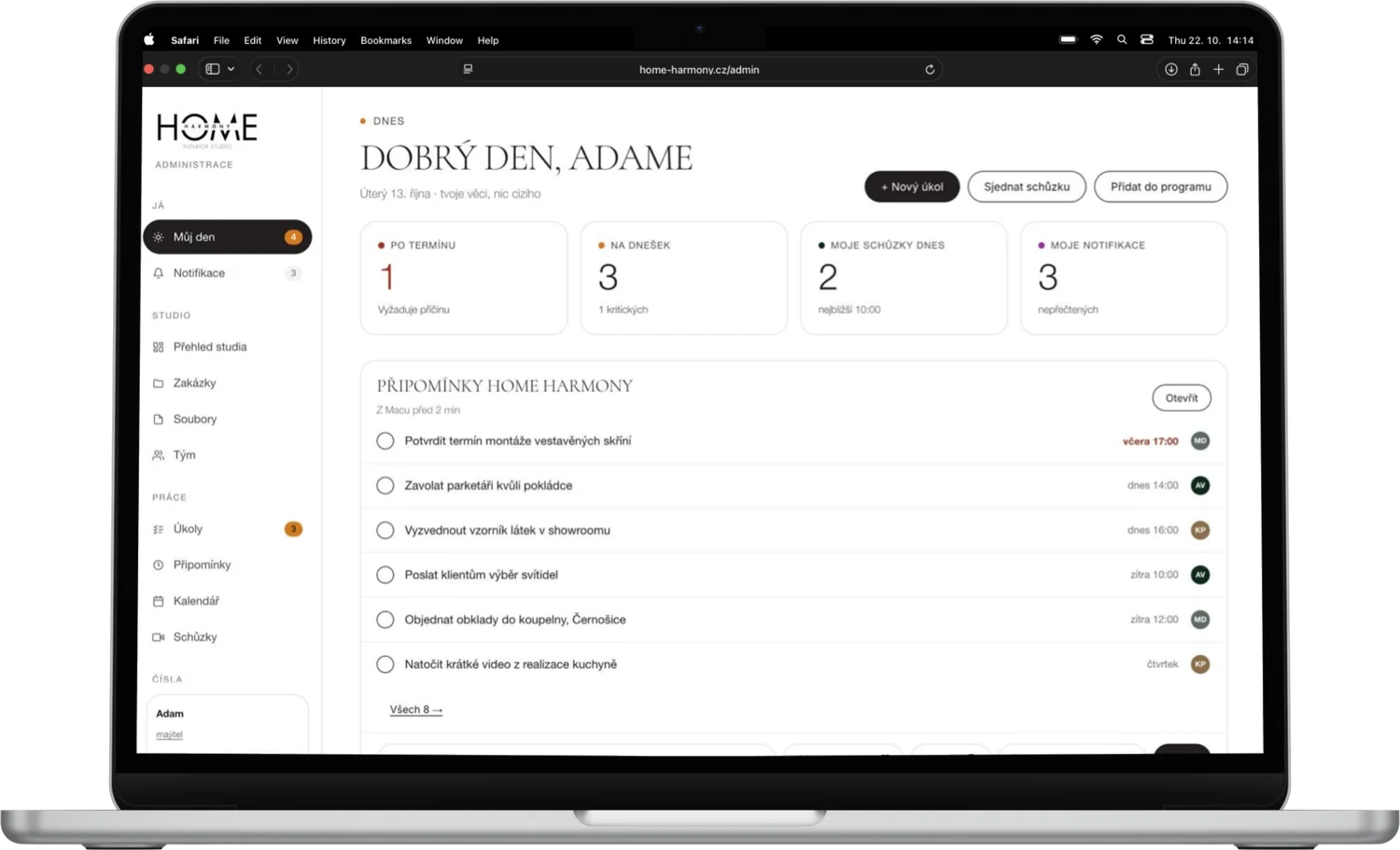
For the studio team we built Můj den, our own app where everyone sees each morning what is urgent, what is on today and who owns what. It has jobs in stages, tasks with notes, a calendar, team chat, finances and invoices per job and phone notifications. That is a system: customers never see it, but work no longer gets lost in e-mails.
The third piece is a social media graphics generator. The studio builds its own posts and stories in its visual style, swaps the photo, text and layout and previews the feed on a phone. A small tool that means the studio does not have to brief a designer for every post.
What holds it together
The website, Můj den and the generator share one visual identity. Clients see a consistent brand and the team works in something that looks like their own company, not someone else's software.
That gives a practical rule for the website or web application decision. If you need more people to get in touch, work on the website. If you need to handle the people who already got in touch well, work on a system. If both, start with whatever costs you more money or time today.
A web application or off-the-shelf software?
Before going custom, it is fair to check whether a ready-made tool will do. There are proven booking services we can connect to the site and match to its look. For invoicing you have accounting software.
A custom web application pays off when ready-made tools force your business into someone else's rules, when you use five of them and copy data between them, or when you need something nobody sells. A custom system can then connect to the tools you already have, such as invoicing, a calendar or a payment gateway.
Step by step
You do not have to do the website and the system at once. We usually suggest starting with what hurts most and adding the other part once the first one proves itself.
- 1A short call: what you do by hand today and where you lose customers.
- 2Free demo: we build a preview of the site, the system or both with your data.
- 3A fixed price upfront, a 40% deposit once you approve the demo.
- 4Build and handover, the balance only after handover.
- 5Next phase: we add a system to the site or new modules to the system when they make sense.
That is exactly how it went with Home Harmony. First the identity and the website, then the move to our own code with new features, and only then the team app and the graphics generator.
A free demo for a website or a system
Still not sure whether you need a website or a web application? You do not have to know upfront. Just tell us how your business runs and what slows you down. We will show you what a website could solve and what a system could, and we build a free demo first.
Get in touch and we will set up a short call. You only pay once you like the result.
FAQ
- 1
What is the difference between a website and a web application?
A website presents the business to customers and brings in enquiries. A web application is a tool for working with data such as bookings, jobs or invoices, and it is often used mainly by the team.
- 2
How much does a custom web application cost?
It depends on which modules you need and what they connect to. We agree a fixed price upfront and build you a free demo first.
- 3
Can I get a website and a system from one studio?
Yes, and the benefit is that they share the same identity and data. At Home Harmony the website, team app and graphics generator all run in one visual style.
- 4
Do I have to build the website and the system at the same time?
No. We usually start with whatever holds the business back most and add the other part in a later phase.
Related project
Home Harmony
Interior studio · web, identity & system
Full case study ›
Want this on your website?
We build you a free demo. You only pay if you like it.